

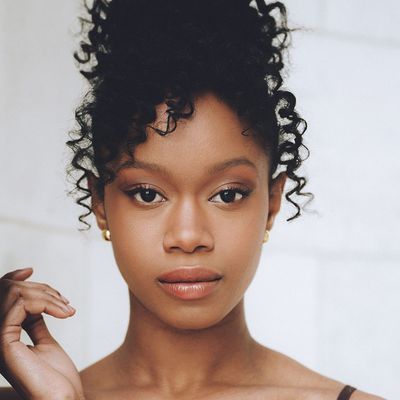
Woods, a rising star of the New York stage, never thought much about "Gypsy" because she never thought there'd be a role for her in the landmark 1959 musical. Now she's appearing opposite Audra McDonald in the new Broadway revival — and finding ways to make the role of Louise her own... Read More
From the show: Stagecraft with Gordon Cox
Guests
Featured Shows
About
Woods, a rising star of the New York stage, never thought much about "Gypsy" because she never thought there'd be a role for her in the landmark 1959 musical. Now she's appearing opposite Audra McDonald in the new Broadway revival — and finding ways to make the role of Louise her own.
Transcript
This transcript was automatically generated and might contain errors.
[0:00] Gordon Cox: Welcome to Stagecraft, Variety's theater podcast, your backstage pass to revealing conversations with stars, creators, and industry leaders, on Broadway, off Broadway, and beyond. I'm Gordon Cox. On this episode of Stagecraft, I'm talking to the actor Joy Woods. She's a performer who's been on the radar of New York theater fans ever since her first gig in the original cast of the off-Broadway revival of Little Shop of Horrors. She initially played one of the three girl group urchins in the show, but would go on to play the romantic lead, becoming the production's first black Audrey. She's also had a run in Six on Broadway, and most recently in The Notebook, the musical in which her performance of the song My Days became a fan favorite and a viral hit.
Now she's starring in her biggest role yet, appearing opposite Audra McDonald in the new Broadway revival of Gypsy. McDonald stars as Broadway's first black Mama Rose, and Woods plays her daughter, Louise, who over the course of the show finds her voice, and finds success, in the world of burlesque as the stripper Gypsy Rose Lee. It's the role that won Laura Benanti a Tony Award in the last Broadway revival of Gypsy in 2008, and now it's a part being played by Woods in a new production directed by George C. Wolfe. Now Woods is in the virtual studio with me to talk about taking on a major role in a legendary show, working with a legendary musical theater star, and changing costumes in Six Seconds Flat. Hi Joy, thanks for being here.
[1:36] Joy Woods: Hi, thank you for having me.
[1:39] Gordon Cox: So as we are talking right now, you are in previews for Gypsy, and you are very, very close to opening. How is it going?
[1:47] Joy Woods: I think now that we've had some days to sleep before our previews, personally I feel ready to open. I don't know if the references during the day... I don't know, you need to sleep to be able to show up, to be rested, and things have begun to click and work for me and my body in those days, so now I feel ready.
[2:14] Gordon Cox: Yeah, that's a challenging time, because when previews start and you're still rehearsing during the day, right? Like, that's a whole, that's a lot of...
[2:20] Joy Woods: It's like 10-11 hours a day.
[2:22] Gordon Cox: Right, right. Nuts.
[2:24] Joy Woods: Yeah, yeah. Was Gypsy a show that you were very familiar with before signing on?
[2:31] Joy Woods: I knew it existed, and I knew it was very loved. I went to theater school, so of course the teachers regarded it as the greatest musical of all time, and now I know why, now I know.
[2:44] Gordon Cox: We're going to talk about that, yeah, yeah.
[2:46] Joy Woods: But, you know, you see the iterations of the show and you don't see anybody that looks like you, and so I disregarded it as something that I will be so excited to see when it comes back but I'll never be a part of.
[3:00] Gordon Cox: Yeah, had you ever seen it or studied it or anything?
[3:05] Joy Woods: No more than clips on YouTube that were shown in class or just come up when you're recommended on when you're doing a doom scroll at 3 a.m. on YouTube, but not much, but enough. I think I watched, actually had seen the movie when I was really young because it was just doing a rerun on TV with Bette Midler, and so the first, I think one of the first musical theater songs I ever knew was Some People, and throughout my life I would just hear that tune and be like, where is that from? It's recognizable, but I don't know it, and good thing I had seen it then, I guess.
[3:49] Gordon Cox: And so, tell me about, so now you have gotten to know the show, tell me about how your impression of it has changed.
[3:57] Joy Woods: So I agree with the queens, the greatest theater pieces of all time. The math in the book is so good. Everything that, I get the arguments to say that it's outdated or that it doesn't exactly stand the test of time in the way that where we are now, it doesn't seem to work for some people, but I think the root of it is people trying to make a living and make things work in a time where what they long for is dying, and especially now where technology and culture, and yes, just those two, because it's a pretty big umbrella, works at an exponential pace. Things don't tend to last long, and so things that you've been clawing your life since you were young to get to, by the time you're old enough to feel like you're really there, it doesn't feel like it's relevant or available or accessible.
Having to reconcile with that truth and sort of deal with the past and the way that you made things work that didn't necessarily benefit the people around you or made you not the best person to the people around you. There's so much truth hitting you in the face over and over and over again, and the way that it's written really reflects the journey that you go on in this show, and something I was just talking about with somebody earlier is that in Gypsy, in any show really, you have to think about why in each scene, why this day, why was this day important to be written about and put in this tale? Especially since this is the recount of someone's actual life, why was this moment important? And I think that they put those together very, very, very well to show the journey of several people, from June recognizing that mother wasn't going to get her to where she needed to be, leading into the scene of all and there's the girl, and Tulsa having his number together so that June could run away with him and make their life, to the burlesque house and Rose reconciling with the truth that mother was dying, to her putting Louise in the scripts, and it's all put together very, very well. I'm a super fan now. I'm rambling about Gypsy. I don't think I'd ever be here.
[6:35] Gordon Cox: And is there anything that you mentioned that you really identified with the journey of an artist, you know, working towards something that may, that some people might consider to be dying or evaporating or going away? And is there anything else that you particularly identify with personally in the role of Louise?
[6:55] Joy Woods: I grew up in a family of six kids, the last. And I don't know, I don't want to turn this into a therapy session. But I think what's safe to say is that you watch your built in best friends grow up and leave and thinking that this is all you've known for your whole life. And just not knowing that abandonment is what you are experiencing as a child. But feeling the need to be seen, having the impulse to be known, is something I think we can all identify with. And so I'm happy that I'm one of the all and can relate to Louise in this way. And just sort of having a moment of this is where I belong, this is what works for me. And whoever does not accept it or understand it can see their way out the door, I think is a place where we both as a lily pad that we both lay on. And the whoever doesn't get it can get out is somewhere that Louise is much more in than I. But it's nice to have a role model in her in that way. Yeah.
[8:13] Gordon Cox: And what has been the biggest challenge for you in the role?
[8:16] Joy Woods: Oh, my God, getting to that place where if you don't like it, you can get out. The dressing room scene leading up to it. Yeah.
[8:25] Joy Woods: I've never been. I think I've been very privileged, very grateful to have the career and trajectory that I've had. And I guess once I'm 50 and looking back on my life, I'll see that, oh, my goodness, girl, you really were fighting for your life. But it hasn't felt that way. Because I guess when you're in survival mode, it just feels like day to day. But getting to that level of I've had enough and needing to stand up to someone, let alone a parent. Yeah.
[8:57] Gordon Cox: In that way is something I've never, ever dabbled in or experienced or had to even touch on in my spirit around myself. So it's been fun. Yeah.
[9:11] Joy Woods: It's been fun. And of course, this is a climactic scene between Louise and her mother, Mama Rose. And the parent figure you are standing up to is Audra McDonald, none other than Audra McDonald.
[9:23] Gordon Cox: I can't believe it. Yeah.
[9:26] Joy Woods: Was she someone whose work or career has been important to you as you've grown into becoming a professional performer? Did you know her?
[9:34] Joy Woods: Oh, my goodness. Yeah. Yes.
[9:37] Joy Woods: Yeah. How has her work been significant for you?
[9:41] Joy Woods: Definitely in learning how to shapeshift. Because I think in theatre, at least in the years, which weren't many, because I was sort of thrown into Little Shop and my career, while I was still pretty young and didn't have much time to continue learning in a school setting, I was taught in those years that I was learning that the roles you will play will be very close to yourself and who you are. And I've been grateful, I think, able to have sort of training wheels in that way and been given roles that do that up until this point.
[10:21] Joy Woods: Here but Brent, you know, I'm being given more challenges with each and every role. But I just saw her as somebody that was able to completely transform. And the tools that she used to transform are something that I was never able to comprehend until I was looking at her in the eyes watching her do it. And I never thought that I'd be able to look in her eyes and watch her do it. This woman is just out of this world. And I think it's all to owe to the person that she is. I've had a few conversations with her about how I was struggling in this, and just to hear how she was struggling in the same way, I'm like, oh, so this isn't—this is a universal experience. You're just like one of us. You're one of us.
And the ego has to continually be dropped. The confidence has to be built brick by brick from the ground up consistently. You don't just build a wall and it stays; you have to keep adding to it over time. There's always more to find. There's always more to do, and to see somebody that you regard this high up in their career is still working on that, it gives you permission to do that too. And of course, I know that I still have to do that if I'm not at this lady's level, but knowing that it never stops makes you want to work harder for them. Yeah, so it's been nice to see the tools that she's using and because I'm her kid using it. Yeah. What are those tools? Can you describe what you've learned about the tools that she uses for what she does?
[12:01] Joy Woods: Voice, the way that she uses the language, even from tonally to prediction in the way that she punches consonants or oozes on vowels. And just really figuring out what the words are and what they're intended to mean. Body language, I don't know if I said that already, and just everything in between. It's the in-betweens that matter the most—the things that get you from one word to the next, the feelings that get you there. And I think for a long time, I say that I really did not—and I'm still very much in the beginning of my journey with Louise—but didn't start to really click with her until these past few days when we started rehearsing and I was able to go home and sleep and then come in and do the show, having time to think about it.
But I think I'm—the last production, Laura Benanti won a Tony. Yeah, I personally don't care if anybody else was putting pressure on me to be good, but I was putting pressure on her to be good. And I think I was just rushing through things trying to get it out there and then go backstage. And she's given me permission to take my time. She's given me permission. And so this is something that's told me throughout the whole rehearsal process that I need to take my space up a little more because I haven't been wanting to do that. Apparently, they say. But I think it's all in the spirit of growing up and finding out who you are and what you mean when you say things. And I think because that's something I can relate to and something I see in her that I'm able to mirror is, yeah.
[14:08] Gordon Cox: I'll have more with Joy right after this break.
[14:17] Gordon Cox: And now back to my conversation with the actor Joy Woods. You mentioned, uh, George—that's George C. Wolfe, the director of the show—and let's talk about the way, um, he's of course another theater great who has had a career as storied as Audra's. But tell me about how you would describe his take on this production because it's not colorblind casting that makes Audra the first, you know, Black Mama Rose. It's very color conscious, and it's a production that's very aware of how Blackness could impact the way the story—what happens in the story, right? Um, so tell me about sort of your take on kind of how this story is told and how it's impacted by the casting.
[15:02] Joy Woods: Well, I think one thing I've noticed throughout our previous process is that a lot of the things that we put into the show to say that this is hashtag Black Gypsy—got to put the hashtag in there because, you know, it's such a—we're not doing this to say that it's a Black Gypsy; it's Gypsy told through African American lines. But hashtag Black Gypsy, a lot of those things are only really seen by other queer Black people—real Black people. I don't know why I would say that, but it's a lot of it is Easter eggs because so much of the experience is universal. The book is written so well that it's a universal experience, especially during the Depression, especially during the end of the '20s when people—when vaudeville is dying and people are making radios and getting onto that sort of medium of entertainment and relax.
People figuring out and adjusting their lives to make themselves be seen and make a living and make things work is not only a white experience. And I think the way that they've told it here with Audra and with June and Louise is done very subtly and very intelligently because I think one of the great things about Gypsy is that it's a classic, and so it doesn't take—I don't know. I see a lot of—you feel an impulse sometimes to reinvent those when they're about it. And I don't know. I think I just agree with the creative team or it doesn't need to be redone, especially when hashtag Black Gypsy feels like such a huge swing. I think telling it through this lens is swing enough, and it has brought in such a large wave of new audience between kids that have never known about Gypsy and just another demographic of people that have never cared about Gypsy because they never saw themselves in it before.
And I think that's important to think about when—I think it's important to think about when people that are diehards for the original productions say that this doesn't do anything new or that it's boring or that it's not true to the original. Art is to make you think and make you feel, and I think it's doing for the intended audience.
[17:32] Gordon Cox: Did you—as you mentioned, this is based on a true story. These are real people you were playing or versions of real people. Did—what was the—was there a research process on your end in terms of learning about Gypsy Rosalie?
[17:45] Joy Woods: A big stack of books right there. Yeah. How did that—how—what was the research you did, and how has that sort of influenced your take on Louise?
[17:54] Joy Woods: I read Gypsy's memoirs, and I've done a lot of looking into the list of books. The one that I have on my desk right here is titled Pretty Things: The Last Generation of American Burlesque Queens by Liz Goldwyn. And it's just a very—oh yeah, it's big. Look at that. Like James Russell and all the movie stars that sort of used burlesque, the Follies and Dolly Sisters. And there's one of, uh—may I read you a please? Yeah. In order to make their mark on the burlesque scene as featured stars, potential queens needed to create and refine their own signature gimmick or act. Gypsy Rosalie has often been quoted as saying, "You gotta have a good..." Hers was the novelty of being an intellectual burlesque queen.
And so we know that Gypsy's gimmick was her being smart, being witty, and her talking to the audience, right? And in the books that I've read, she is so funny; she is so smart. Her dedication in the original memoir that I've done here is, "This is for my son Eric, so he stops asking too many questions." Like, that's hilarious, girl. And just to have written an entire life story just to shut up some mouths gives you just even that enough insight as to who she was as when she came into herself.
[19:35] Joy Woods: So I really enjoy doing my research, if you can tell.
[19:39] Gordon Cox: Do you enjoy the burlesque part of the parts of the show, the stripping numbers? Because that's just another form of story—like a great burlesque number is a form of storytelling, right?
[19:49] Joy Woods: Yes, and there are a lot of changes in between each one. I learned yesterday that one of our changes is only six seconds. It's a whole dress, wig, makeup, earring situation—six seconds. So I think trying to figure out how to survive those few seconds between each one was the focus at first—show up at the right time in the right clothes. Um, and now I'm getting down fun because we got those parts down. Yeah, it is really fun to have a journey and physical and energetic and verbal confidence growing and to show that journey. I'm still finding it, and one thing I love about long runs—this is the longest one I'll have done by the time we're into it, we're at the end of it. Um, but I hope it never stops growing.
[20:43] Joy Woods: I don't know. The reviews and things don't really matter to me because that's where we get at the very end of our very last show. It's a culmination of all we've found and all that we've built. So, yeah, I am happy to be putting the puzzles into the piece right now, but it's only at the beginning. I'm having fun, but it's just begun.
[21:09] Gordon Cox: You've been performing professionally and working pretty nonstop, as you mentioned, basically since you were 19 years old. At what point did you know that theater was something you wanted to pursue professionally?
[21:21] Joy Woods: I think I knew in my junior year of high school or maybe my senior year. I started doing theater junior year for fun because my sophomore year, my friend took me to see the school musical. It was The Addams Family. It was fantastic. They were singing and dancing and acting. I said, this looks fun. Let me try.
[21:41] Gordon Cox: You grew up outside of Chicago, is that right?
[21:44] Joy Woods: I did, in Southside. And one of the first shows that we did, you're in my dressing room, so I have to show you things.
[21:52] Gordon Cox: Show me, yeah.
[21:53] Joy Woods: I have a lot of clothing of a year with Frog and Toad. I have three shirts in here that are Frog and Toad.
[22:08] Gordon Cox: Yeah, that's a T-shirt for listeners. You just held up a T-shirt with a little picture of Frog and Toad.
[22:13] Joy Woods: We should explain. I love Frog and Toad. That was so much fun. High school theater, that energy is so niche and fun. Between feeling comfortable in a space, finally, and feeling like I was capable of something, and having that sort of community where, at this point, all of my siblings were pretty much grown up and out of the house, I was searching for one. To feel like I found one, it was affirming. To feel like I knew where I was going.
[22:51] Gordon Cox: It wasn't much long after that that you started in Little Shop, right?
[22:55] Joy Woods: No. It was exactly a year after I graduated high school. My goodness, yeah. Maybe a year and a month.
[23:04] Gordon Cox: What of the gigs you've had so far would you consider the biggest learning experience for you?
[23:10] Joy Woods: I guess I'll work my way backwards. I learn from the book how to show up every day. Gypsy is teaching me how to release ego. It's teaching me how technique is my friend. Whereas, it was a crutch before. Little Shop taught me how to have fun. Dude, Little Shop was so much fun every day. Every time that I was there, because I would leave and come back and leave and come back so many times. Throughout each time that I was there, it was have fun or else. But I think this one is probably the most challenging. There will be a lot to learn, because there is no singing or anything to hide behind. That apparently has been my crutch for a very long time, and I didn't know.
[23:55] Gordon Cox: Oh, yeah. That's interesting. That had never occurred to me that you're mentioning the singing.
[24:03] Joy Woods: Well, that's funny, because I started my life as a dancer. And when I started working, no jobs were asking me to do that. And I was so insecure. And I was like, I'm not a good singer. I'm not a good actor. I don't know why people are hiring me to do these things. And each process has been proving to myself that I meant to be there, that I was meant to be there in the first place. And now, after the my days of it all, after the summer that's green, suddenly see more, the hashtag sticks of it all. I started to feel like maybe I could sing a little bit. I'm not really doing any of that. And I really do just have to rely on my ability to say words and listen. Which is what an actor is. I know that. And to feel confident in that is the next step.
[24:55] Gordon Cox: Yeah. You mentioned my days, which was a song that was became very popular.
[25:01] Joy Woods: Yeah.
[25:02] Gordon Cox: Sort of theater TikTok. What was your experience of that popularity?
[25:07] Joy Woods: It's funny because this morning, a friend of mine sent me a video of Natalie Weiss, an edited video that she posted. It just fits. And we're trying to figure out the key change in that song and my days. And also, when I was in middle school, in music class, our teacher would put on her Breaking Down the Riffs videos at the end of class. I was like, no, this lady is a big fan. And just to see that she was trying to break down this song. And I commented, this is something that I would do trying to figure out this song every day when we did our out of town and our appointments. If I could send a letter to everybody that was on my floor at the time apologizing, I would. Because it was a very difficult thing.
It was a very scary thing. And it's like burying your heart, like everything that you have. This is all I have to give to this song. It's not an easy one. I'm really grateful to Ingrid for trusting me with it. But it's hard. And so when you put it out there and it's received like that, it means the world.
[26:20] Gordon Cox: And what was the question that you asked?
[26:23] Joy Woods: That was the question. What's your experience of it?
[26:26] Gordon Cox: That experience was, yeah. It must be, as you mentioned, just to see a YouTube breakdown of that you would have watched earlier in your life. To see that happen with the work that you were doing now must have been quite satisfying.
[26:41] Joy Woods: Yes, it was. And I'm happy that it's being received the way that it is. And I can't wait to never sing it again unless paid much for it.
[26:54] Gordon Cox: Yeah, you might be singing that for a while now still. But maybe not quite as often right now when you're doing Gypsy.
[27:00] Joy Woods: It was a great catharsis every night. I'll tell you that's for sure. I was having a hard day. I could just scream about it during that part in the show.
[27:12] Gordon Cox: Who do you consider your influences as a performer?
[27:14] Joy Woods: Now that I come to think of it, maybe the reason why I'm struggling here so hard, or not struggling, but have struggled and learning and will continue to learn, is that my influences and the people that I looked at were always musicians rather than actors or dancers. And so this portion of my artistry, I haven't done the amount of research and just had past simmering in my personal pot of streets and know what to look at and where to go, anyone other than Audra. And so the one person that I was really looking at is now right in front of me. It's overwhelming. And so I haven't, and I've been moving around so much because I was young in New York and trying to figure out my life. I never ended up getting a TV.
So I haven't watched much TV either. So I can't say that I had any good actors to look at either. But I can really appreciate anyone that uses their language, that pays attention to words and how they're meant to be said. And that's something that she was really, really a big fan of it. So I'm happy to be learning from her right now.
[28:33] Gordon Cox: Yeah. So you are, as you said, you're in Gypsy for the foreseeable future, but like all shows, you're not going to be in it forever. What do you envision is next for you?
[28:44] Joy Woods: I think I've felt this way a bit. There's been a few times now where my dreams have come true before I've been able to make them. And amazing things have happened before I was able to even envision them happening to me. And I feel like Gypsy was one of those things. I never saw this happening. I never imagined that I'd be in Gypsy, let alone that Audra would be doing, let alone that I would be a part of it. And then playing Louise on top of all of that. So I feel like I'm sort of being pushed out of my comfort zone in this stage. And that it may be that I have to learn everything that I was brought here to learn so that I can branch out. I'm not sure what the branching out looks like, whether that be TV or film. But I think my goal is to keep learning and keep stepping out of my comfort zone to do that. Because I'm not learning anything when I'm playing that.
[29:44] Gordon Cox: It's always good. Well, we can't wait to see what you learn next and how you learn it. And to watch your Louise evolve over your time in Gypsy. Thanks so much for talking with me, Joy. It was great to speak with you.
[29:58] Joy Woods: Thank you so much. And happy opening in a few days.
[30:02] Gordon Cox: This episode is going to come out just a few days after opening. But we are talking just a few days before. So happy opening. Enjoy it.
[30:09] Joy Woods: Oh, I will.
[30:10] Gordon Cox: That was Joy Woods, now starring in Gypsy at the Majestic Theatre on Broadway.
[30:23] Gordon Cox: If you enjoyed this conversation here on StageCraft, help us out. We'd so appreciate it if you would take the time to rate and review us on your favorite podcasting app. It really does help. Or tell a friend about StageCraft. Find past episodes and subscribe at all the places you get your pods, including Apple Podcasts, Spotify, and on the Broadway Podcast Network, a great place to find more theater for your ears. Until next episode, find me on Instagram and X at Gordon B. Cox. You can also check out my newsletter about international theater. It's called Jaquies, and it's at GordonCox.Substack.com. Thanks for listening and see you at the theater.
© Broadway Podcast Network, All Rights Reserved